Conference Profile
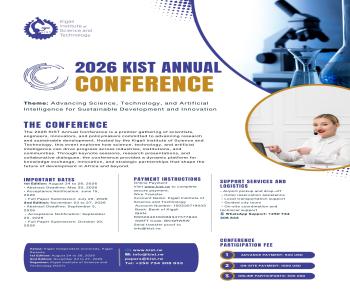
About Conference
Kigali Institute of Science and Technology (KIST)
2026 KIST Annual Conference
Theme: Advancing Science, Technology, and Artificial Intelligence for Sustainable Development and Innovation
📍 Venue: Kigali Independent University, Kigali Rwanda
📅 1st Edition: August 24 - 28, 2026
📅 2nd Edition: November 23 - 27, 2026
🏢 Organizer: Kigali Institute of Science and Technology (KIST)
📧 Email: info@kist.rw | papers@kist.rw
🌐 Website: www.kist.rw
About the Conference
The 2026 KIST Annual Conference is a premier global forum dedicated to advancing scientific research, technological innovation, and collaboration across Africa and the international community. As the flagship event of the Kigali Institute of Science and Technology, the conference is designed to promote high-impact knowledge exchange, strengthen institutional partnerships, and inspire the next generation of scientific and technological leaders.
The conference focuses on the critical intersection of science, engineering, technology, and artificial intelligence, exploring how these fields can drive progress in education, industry, environmental management, health systems, governance, and socioeconomic development. By highlighting innovative practices, emerging research trends, and transformative digital tools, the conference aims to position KIST as a continental center of excellence in research, innovation, and capacity building.
Held in two editions to maximize participation and engagement, the conference provides an inclusive environment for academic researchers, engineers, policymakers, private sector actors, development agencies, and students to share insights, present research findings, and engage in structured dialogues that shape future scientific directions and development agendas.
Participants will engage in keynote addresses delivered by distinguished scholars and global experts, followed by peer-reviewed scientific paper presentations, thematic panel sessions, industry demonstrations, exhibition showcases, policy roundtables, technical workshops, and networking events. These sessions are tailored to stimulate intellectual growth, promote cross-disciplinary learning, and foster practical collaboration that supports national and regional development goals.
A strong emphasis is placed on the role of artificial intelligence and intelligent digital systems in powering innovation, enhancing institutional efficiency, improving service delivery, and supporting sustainable development. The conference also examines how science and technology can be harnessed to tackle contemporary challenges such as climate change, public health crises, environmental degradation, urbanization pressures, and rapid industrial evolution.
By serving as a platform for knowledge mobilization, scientific advancement, and strategic collaboration, the 2026 KIST Annual Conference is positioned to contribute meaningfully to global academic discourse and support Africa's transition toward a knowledge-driven, innovation-led future.
Objectives of the Conference
The 2026 KIST Annual Conference is designed to advance a comprehensive set of strategic, academic, scientific, and developmental objectives that align with regional and global priorities in research, innovation, and sustainable development. The objectives reflect KIST's commitment to fostering excellence in science and technology while promoting inclusive development and institutional transformation.
The key objectives of the conference include:
• To promote high-quality scientific research, technological innovation, and interdisciplinary collaboration across diverse academic and professional fields.
• To explore the transformative role of artificial intelligence and intelligent digital systems in enhancing productivity, service delivery, and societal development.
• To strengthen partnerships between universities, research centers, industry leaders, government institutions, and development organizations for shared growth and innovation.
• To provide a platform for researchers and professionals to present empirical findings, applied research, and evidence-based solutions to contemporary development challenges.
• To highlight emerging trends, technologies, and methodologies that can support digital transformation, industrial growth, environmental sustainability, and institutional modernization.
• To encourage the development of competitive scientific and technological capabilities in Africa through knowledge sharing, mentorship, and professional development.
• To support the advancement of policy frameworks that integrate scientific research, digital technologies, and innovation into national and regional development agendas.
• To build networks that enable collaborative research projects, innovation initiatives, and long-term capacity-building programs for academic and professional communities.
• To inspire students, young researchers, and early-career professionals to pursue cutting-edge research, creative problem-solving, and innovation-driven careers in science and technology.
Sub-Themes
The 2026 KIST Annual Conference is organized around a set of multidisciplinary sub-themes that reflect the evolving landscape of scientific research, technological innovation, and sustainable development. These sub-themes provide structure for academic paper submissions, workshop sessions, keynote discussions, and policy dialogues. They also ensure that the conference captures the full breadth of contemporary scientific inquiry and emerging development needs.
1. Science, Research Excellence, and Knowledge Innovation
This sub-theme focuses on the advancement of scientific discovery, research methodologies, academic excellence, and knowledge production. It explores the role of scientific inquiry in solving societal challenges and strengthening innovation ecosystems.
Topics include:
• Scientific research and applied studies
• Research methodologies, laboratory innovations, and scientific instrumentation
• Knowledge transfer, intellectual property, patents, and research commercialization
• Strengthening STEM research, academic excellence, and global scientific collaboration
2. Engineering, Technology, and Industrial Transformation
This sub-theme highlights engineering solutions and technological innovations that improve industrial productivity, infrastructure resilience, and economic competitiveness.
Topics include:
• Engineering technologies for industrial modernization and automation
• Transport, energy, and infrastructure systems enhanced through modern engineering
• Sustainable manufacturing processes and production innovations
• Technology enabled urban development, smart city design, and infrastructure management
3. Artificial Intelligence, Data Systems, and Intelligent Tools
This sub-theme examines the expanding role of artificial intelligence and digital technologies in shaping the future of institutions, industries, and social systems.
Topics include:
• Artificial intelligence applications in health, education, agriculture, and governance
• Data science, analytics, and digital decision-support systems
• Intelligent automation and robotics for industrial and service sectors
• Data governance, privacy, digital ethics, and secure data management models
4. Environmental Sustainability, Climate Resilience, and Resource Management
This sub-theme addresses the scientific and technological responses required to promote environmental protection, climate adaptation, and sustainable natural resource management.
Topics include:
• Climate change mitigation, adaptation research, and environmental monitoring
• Natural resource management, ecosystem conservation, and biodiversity protection
• Green technologies, renewable energy, and circular economy solutions
• Urban resilience, environmental planning, and policy frameworks for sustainability
5. Institutional Development, Capacity Building, and Leadership
This sub-theme focuses on the role of strong institutions, skilled professionals, and effective governance systems in advancing science, technology, and development.
Topics include:
• Higher education governance, digital transformation, and institutional modernization
• Professional training models for science, engineering, and technology sectors
• Leadership development, innovation culture, and organizational capacity strengthening
• Multi stakeholder partnerships for research, innovation, and sustainable development
Expected Outcomes
The 2026 KIST Annual Conference is designed to generate high-value academic, institutional, developmental, and collaborative outcomes that contribute to national, regional, and global knowledge systems. By convening experts across science, engineering, technology, and artificial intelligence, the conference aims to produce measurable impacts that extend beyond the event itself and strengthen the long-term capacity of research and innovation communities.
Key expected outcomes include:
• Strengthened scientific collaboration among universities, research institutions, government agencies, industry partners, and international organizations.
• Publication of high-quality academic papers in the KIST Annual Conference Proceedings, contributing to global knowledge repositories and promoting research visibility.
• Enhanced institutional capacity for research, innovation, and digital transformation through shared best practices, case studies, and policy discussions.
• Practical recommendations for policymakers, industry leaders, and development agencies on integrating science, technology, and artificial intelligence into sustainable development strategies.
• Creation of multidisciplinary research networks and partnerships that support joint projects, innovation initiatives, and academic exchange programs.
• Increased visibility of KIST as a regional hub for scientific research, technological advancement, professional training, and academic excellence.
• Empowerment of early-career researchers, postgraduate students, and emerging scientists through mentorship, exposure to global expertise, and opportunities for professional growth.
• Strengthening of industry-academia collaboration to accelerate innovation, enhance competitiveness, and bridge skills gaps in key development sectors.
• Enhanced understanding of the role of artificial intelligence and intelligent digital systems in shaping the future of society, governance, education, manufacturing, health, and environmental protection.
• Development of a collaborative agenda that positions science and technology as central pillars for sustainable development across Africa.
Who Should Attend
The 2026 KIST Annual Conference is designed to bring together a broad and diverse community of participants representing academia, industry, government, and development sectors. The event is structured to accommodate professionals at all levels, creating a dynamic platform for collaborative learning, knowledge exchange, and cross-disciplinary engagement.
The following groups are strongly encouraged to attend:
• Scientists, Researchers, and Academics
Professionals across scientific fields seeking to share research findings, explore new methodologies, and collaborate on cutting-edge innovations.
• Engineers, Technologists, and Innovation Specialists
Experts in engineering, digital technologies, and applied sciences who contribute to industrial transformation and technological progress.
• Artificial Intelligence, Data Science, and Digital Transformation Experts
Professionals working with intelligence systems, analytics, automation, and digital platforms seeking to explore emerging opportunities and best practices.
• Industry Leaders, Corporate Executives, and Private Sector Professionals
Organizations and businesses focused on manufacturing, energy, technology, engineering, environmental protection, and digital innovation.
• Government Ministries, Public Sector Institutions, and Policymakers
Representatives involved in national planning, science and technology policy, environmental protection, education reform, digital governance, and innovation development.
• Development Partners, International Agencies, and NGOs
Organizations supporting science, technology, education, climate resilience, and sustainable development initiatives.
• University Administrators, Institutional Leaders, and Education Managers
Stakeholders responsible for academic governance, research management, institutional transformation, and capacity building.
• Postgraduate Students, Young Researchers, and Emerging Innovators
Early-career professionals seeking mentorship, knowledge exposure, publication opportunities, and international networking.
• Environmental and Climate Specialists
Professionals working in conservation, climate adaptation, climate research, environmental planning, and green development.
• Health, Agriculture, and Public Service Practitioners
Experts applying technology and research in critical sectors to improve service delivery, resilience, and sustainable development outcomes.
This wide spectrum of participants ensures a rich exchange of ideas, perspectives, and expertise, fostering a collaborative environment that strengthens innovation ecosystems and research capacity across Africa and beyond.
Paper Submission Guidelines
The 2026 KIST Annual Conference invites high-quality research papers, case studies, technical reports, conceptual analyses, and innovative project summaries that align with the conference theme and sub-themes. All submissions will undergo a rigorous peer review process to ensure academic integrity, originality, and relevance to contemporary scientific and technological discourse.
Submission Requirements:
• Abstract Length: Maximum of 300 words
• Full Paper Length: 4000 to 6000 words
• Font and Format: Times New Roman, 12pt, double-spaced
• File Type: Microsoft Word document (doc or docx)
• Structure:
· Title of the paper
· Author name or names
· Institutional affiliation
· Contact email address
· Abstract and keywords (maximum of 5)
· Main body with clearly structured sections
· Conclusion and recommendations
· References in APA or Harvard format
Important Notes:
• All papers must be original and must not have been previously published or under review elsewhere.
• Papers should align with one of the identified sub-themes, but cross-disciplinary work is also welcome.
• Accepted papers will be scheduled for oral or poster presentation at the conference.
• All accepted papers will be published in the KIST Annual Conference Proceedings Series (ISSN).
• At least one author of each accepted paper must register and participate in the conference.
Submission Channels:
Authors should submit their abstracts and full papers to:
📧 papers@kist.rw
Acknowledgment of receipt will be provided within 48 hours, followed by review updates according to the conference schedule.
Important Dates
The 2026 KIST Annual Conference will be delivered in two editions to ensure greater regional and international participation. Authors and participants are encouraged to take note of the following key deadlines to ensure timely submission and registration.
1st Edition: August 24 to 28, 2026
• Abstract Submission Deadline: May 30, 2026
• Notification of Acceptance: June 15, 2026
• Full Paper Submission Deadline: July 20, 2026
• Conference Dates: August 24 to 28, 2026
2nd Edition: November 23 to 27, 2026
• Abstract Submission Deadline: September 5, 2026
• Notification of Acceptance: September 20, 2026
• Full Paper Submission Deadline: October 20, 2026
• Conference Dates: November 23 to 27, 2026
Additional Notes:
• Submissions received after the deadlines may be considered for future editions but not guaranteed for the current year.
• Authors are strongly encouraged to submit early to allow sufficient time for peer review and revisions.
• Participants will receive final conference schedules, presentation guidelines, and program booklets prior to each edition.
Participation Fees
To support the successful delivery of the 2026 KIST Annual Conference, the participation fees have been structured to accommodate both in-person and virtual attendees. These fees contribute to conference materials, venue arrangements, publication processing, technical support, hospitality services, and overall event administration.
Participation Fee Structure for All Editions:
• Advance Payment: 500 USD
Participants who complete their registration and payment before the deadline will benefit from the discounted advance rate.
• On-site Payment: 1000 USD
This applies to participants who choose to register and pay upon arrival at the conference venue. On-site payment is accepted in cash only.
• Online Participants: 500 USD
Virtual attendees will receive full access to all online plenary sessions, parallel sessions, workshop content, and digital conference materials.
What the Participation Fee Covers:
• Full conference admission for all days
• Access to keynote presentations and panel sessions
• Participation in workshops and technical sessions
• Conference materials including program booklet, badge, and documentation
• Electronic copies of the KIST Conference Proceedings
• Tea and lunch breaks during all in-person sessions
• Official certificate of participation or presentation
• Technical support for virtual participants
Important Notes:
• Each accepted paper requires at least one registered author to ensure its inclusion in the conference proceedings.
• Group registrations, institutional delegations, and corporate teams are permitted but each participant must register individually.
• Refunds for cancellation requests will be considered only under exceptional circumstances and based on KIST conference policy.
Payment Instructions
Participants may complete their conference registration through any of the secure payment methods provided below. Early payment is encouraged to guarantee participation, secure advance rates, and confirm the inclusion of accepted papers in the conference proceedings.
1. Online Payment
Participants may visit the official KIST website to make a secure online payment using the available payment options.
The online platform is optimized for local and international payments and provides automatic confirmation upon successful completion.
2. Wire Transfer
Participants may also make payments via bank transfer using the following details:
Account Name: Kigali Institute of Science and Technology
Account Number: 100230719033
Bank: Bank of Kigali
IBAN: RW50040100089347577840
SWIFT Code: BKIGRWRW
Important Instructions for Wire Transfers:
• Ensure that your full name appears clearly in the payment reference section.
• Use the reference phrase: KIST Annual Conference 2026.
• After completing the transfer, email a copy of your payment receipt or transfer confirmation to:
📧 info@kist.rw
This will fast track verification and issuance of your official conference receipt.
Payment Confirmation and Receipts
Once payment is received and verified, a digital confirmation and receipt will be emailed to each participant.
Participants are advised to keep their payment proof for registration and accreditation purposes during the conference.
Institutional or Delegation Payments
Organizations submitting payments for multiple participants must provide a list of all names corresponding to the payment reference. Group payment receipts will be issued upon confirmation.
Support Services and Logistics
To ensure a seamless and enjoyable experience for all participants traveling to Kigali for the 2026 KIST Annual Conference, a comprehensive support system has been established. These services are designed to provide comfort, convenience, and professional assistance throughout the duration of the conference.
Available Support Services
• Airport Reception and Transportation
Participants may request airport pickup and drop off services to ensure safe and smooth arrival and departure.
Professional drivers will be assigned to transport delegates between the airport, hotel, and conference venue.
• Hotel Accommodation Assistance
KIST offers support in securing hotel reservations at preferred rates with partner hotels located close to the conference venue.
Accommodation options include budget, mid-range, and premium hotels to suit participant preferences.
• Local Transportation Coordination
Delegates may request assistance with local transportation arrangements, including shuttle services to and from the venue and scheduled conference activities.
• Guided City Tours and Cultural Experiences
Optional guided tours are available for participants wishing to explore Kigali and its attractions.
These include historical sites, cultural centers, museums, art markets, and scenic destinations.
• On site Delegate Support
A dedicated support team will be accessible throughout the conference to assist participants with accreditation, session navigation, logistics inquiries, and any emerging needs.
WhatsApp Support Line
📱 +250 734 308 833
This communication line is available 24 hours daily to provide real time assistance before, during, and after the conference. Participants are encouraged to reach out for any support required.
Service Notes
• All services are optional and subject to early confirmation before arrival.
• Prior booking is recommended to ensure availability of transportation, accommodation, and tour slots.
• International participants are advised to arrange their travel documentation and medical requirements in advance.
Contact Details
Participants, institutions, and partners are encouraged to use the official communication channels listed below for all conference related inquiries, submissions, confirmations, and support requests. The conference team is committed to providing prompt and professional assistance throughout the entire engagement process.
General Inquiries and Communication
📧 info@kist.rw
For questions about registration, participation, logistics, support services, and general conference information.
Paper Submissions and Academic Correspondence
📧 papers@kist.rw
For abstracts, full papers, editorial communication, and all matters relating to scientific review, presentation scheduling, and publication.
Official Website
The website provides updated conference information, online payment options, downloadable forms, program schedules, announcements, and other essential resources.
Direct Phone and WhatsApp Support
📞 +250 734 308 833
Available for urgent inquiries, rapid communication, coordination support, and real time guidance.